The Pump Catalogue I Rejected: Specifying Husqvarna Equipment for a Landscape Crew
It started with a Monday morning email
In March 2024, I was three weeks into our Q1 quality audit. I am the quality and brand compliance manager at an outdoor power equipment dealership. I review every equipment bundle and spec sheet before it reaches customers. Roughly 240 items a year. I rejected about 19% of first deliveries in 2024 because of spec mismatches, missing documentation, or parts that looked fine on a spreadsheet but failed on a job site.
A landscape contractor sent over a quote request. He wanted to update his crew's equipment list. He needed a Husqvarna garden tiller for bed prep, a review of the Husqvarna chainsaw lineup for his tree crew, an 18V pressure washer for quick cleanups, and a submersible pump catalogue for a drainage job. Then he asked the question that changed the whole review: What does a centrifugal pump do?
Honestly, my first thought was, 'That's a Google question.' But it wasn't. It was a spec question, and spec questions are my job.
What I thought I knew
Everything I'd read about outdoor power equipment said go for max power. Bigger cc. Higher psi. More flow. The conventional wisdom is simple: if you can afford the larger spec, buy it. In practice, I found the opposite for a mixed crew. The best spec is the one that matches the actual job, the crew's habits, and the battery platform already on the truck.
Most buyers focus on horsepower or psi and completely miss flow, duty cycle, nozzle size, and whether a pump can handle dirty water. The question everyone asks is 'what's the biggest?' The question they should ask is 'what's it doing for eight hours?'
That was my first mindshift. I stopped treating the top number on a brochure as the quality target. A quality spec is basically an application match.
The Husqvarna list looked easy
The Husqvarna chainsaw lineup was the easy part. Husqvarna publishes clear use cases: small limbing saws, mid-size farm and ranch saws, and professional saws for arborists and loggers. I matched the crew's cutting volume to three sizes instead of buying one do-everything saw. That's a quality issue, not a sales issue. An oversized saw wears out a crew. An undersized saw creates unsafe workarounds.
The Husqvarna garden tiller was also straightforward. The contractor needed a walk-behind tiller for compact beds and rocky soil. We checked tine design, tilling width, and transport weight. A tiller that's too heavy for a one-ton truck and two guys is not a professional tool. It's a return waiting to happen. At least, that's been my experience with landscape crews who work tight residential lots.
Then we got to the 18V pressure washer. The contractor already ran Husqvarna 18V batteries on trimmers and blowers. He wanted a cordless pressure washer for quick rinses: trailer decks, equipment pads, muddy boots. I had to set expectations. An 18V pressure washer is not a replacement for a gas or corded unit. It's a convenience tool. If you sell it as a heavy-duty cleaner, you'll get warranty claims and angry calls. If you sell it as a fast cleanup tool on the same battery platform, it earns its space on the truck.
That said, not every job needs a pressure washer at all. Sometimes a hose and brush is the right answer. A good supplier should tell you that, even if it means a smaller sale.
The submersible pump catalogue was where it went sideways
The supplier sent a submersible pump catalogue as a PDF. It had 14 models. The first page led with max flow. The contractor's drainage job needed to move water from a low spot about 20 feet up to a ditch. He also mentioned sediment, not clean water.
The numbers said pick the highest-flow model. My gut said stop. I've learned that when a catalogue leads with one big number, the important stuff is usually buried. I asked the supplier for the pump curve, seal materials, and solids handling rating.
Two days later, the answer came back. The high-flow model moved a lot of water at zero head. At 20 feet of head, its flow dropped hard. It also had a seal not rated for gritty water. The mid-range model had lower max flow but held up better on the curve and had a better seal. It cost about $180 more. On a $6,000 drainage job, that's not a budget-breaker. It's insurance.
The high-flow model looked professional. What I mean is it had a bigger number on the front page. The mid-range model was professional because it worked in the actual hole.
That was the moment I stopped treating max flow as a quality spec. Flow at the actual head pressure is the spec. Everything else is marketing.
So when the contractor asked, what does a centrifugal pump do? I gave him the plain version: a centrifugal pump uses a spinning impeller to push water outward, converting speed into pressure. It's good for moving large volumes of low-viscosity liquid, like water, through irrigation, drainage, or transfer lines. It's not a trash pump unless it's built for solids. It's not a dosing pump. And it won't pull water up from a dry hole unless it's self-priming or sitting in the water as a submersible.
That explanation belonged in the quote. Not in a text after the sale.
The rejection
I rejected the first pump package. Not because the pump was bad. Because the submersible pump catalogue did not include the curve, the seal spec, or a clear duty cycle. The vendor claimed it was within industry standard. Maybe. But our contract now includes application data requirements for pumps: head pressure, flow at head, solids handling, seal material, voltage, and continuous vs intermittent duty.
The redo cost the supplier about $3,800 in admin time and freight. It also pushed the customer's drainage start by six days. That stung. But the alternative was a pump failing in a muddy hole on a Friday afternoon. I've seen that movie. It ends with a $9,000 emergency rental and a customer who never trusts your spec sheet again.
Here's where I had to be honest about scope. We are not a pump engineering firm. We sell and support Husqvarna equipment. We know the Husqvarna chainsaw lineup, the garden tiller range, and the 18V platform well. We can read a submersible pump catalogue, but we should not design a drainage system. That's a different expertise.
What I changed after that job
I stopped pretending our dealership was a pump specialist. I also stopped letting sales reps promise one-stop solutions for everything on a contractor's list. A one-stop promise sounds good until a pump burns out or a tiller is too wide for a gate.
The best vendor conversation I had that quarter was with a pump supplier who said, 'This isn't our strength. Here's who does it better.' That earned my trust for everything else. It's the same principle I use with customers. I'd rather say, 'For this part, talk to a pump specialist,' than sell something we can't support.
That's the expertise boundary. Focus beats a one-stop promise. A supplier who knows their limits is easier to verify than one who claims to do everything. Plus, it makes the handoff cleaner when the customer knows who owns which problem.
As of January 2025, I keep a one-page spec sheet for every equipment category we sell. It lists what we support, what we don't, and who to call when the job crosses the line. It's not fancy. It just prevents the kind of redo that costs more than the upgrade.
The takeaway
If you're specifying outdoor power equipment for a professional crew, don't start with the biggest number on the page. Start with the job. Match the Husqvarna chainsaw lineup to cut size and frequency. Match the Husqvarna garden tiller to soil and transport. Treat an 18V pressure washer as a battery-platform convenience, not a gas replacement. And for pumps, read the submersible pump catalogue like a quality document, because it is one.
Ask what a centrifugal pump does before you buy one. Ask where it will sit, what it will move, and for how long. The answers will keep you out of the kind of redo that costs more than the upgrade. And if a supplier tells you they don't do something well, listen. That's usually the most professional thing they can say.
Product specs and availability change. Verify current Husqvarna models, battery compatibility, and pump performance data with an authorized dealer or the official Husqvarna catalog before ordering.
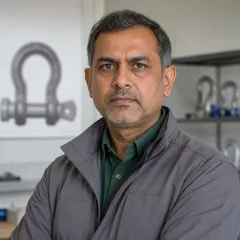
Rajiv Menon
Rajiv Menon is an independent rigging and lifting hardware analyst covering shackles, chain hoists, hooks, turnbuckles, wire-rope clips, and lifting attachments. He applies ISO 2415:2022 shackle requirements while evaluating working load limit, grade, proof load, design factor, pin fit, sling angle, reeving, brake behavior, identification, inspection, and temperature range. His safety-led guides help lifting teams and purchasers select compatible hardware, interpret markings, establish inspection criteria, and avoid side loading or undocumented substitutions.